
LunaBat DFR-1
Ultrasound Detector with embedded Broadband Direct Full Spectrum Recorder and FD-type live detection
(DISCONTINUED PRODUCT)
SEE MORE RECENT LunaBat DFR-1 PRO HERE
 Detector LunaBat DFR-1 (standard / old version)
ONE OF THE SMALLEST HANDY DETECTOR WITH HIGH QUALITY FULL SPECTRUM RECORDER WITH TEMPERATURE & HUMIDITY SENSOR* AND OPTIONAL MULTISYSTEM GNSS RECEIVER FOR LOGGING ON GOOGLE MAPS & GOOGLE EARTH
Easy to use, compact and lightweight, broadband ultrasound detector equipped with a specialized Broadband HF Direct Full Spectrum SD-Card Recorder and FD-type detection for live listening of ultrasounds on embedded speaker or headphones. Integrated recorder enables high resolution recording of ultrasounds, not distorted by detecting circuits. In contrast to any commercially available digital recorder (like Korg MR-2, Sony PCM-D100) can also record the echolocation of the Lesser horseshoe bat (Rhinolophus hipposideros) – see: the last picture in SPECTROGRAMS tab.
* – In 2015 year, when LunaBat DFR-1 was first introduced it was the smallest handy detector with full-spectrum recording capability and only one detector with humidity and temperature sensor. Even in 2020 it was still one of the smallest (if not smallest at all) handy SD full-spectrum recording detector with high quality dedicated sigma-delta analog-to-digital converter and very high dynamic range and negligible distortions (especially: aliasing distortions).
SIMPLE AND CONVENIENT OPERATION WITH HIGH QUALITY RECORDING
NOW WITH 3-YEAR WARRANTY AND FREE WORLDWIDE SHIPPING !
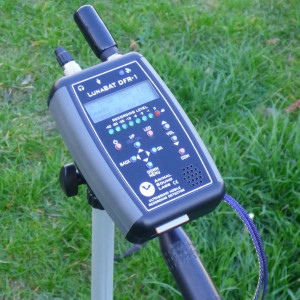
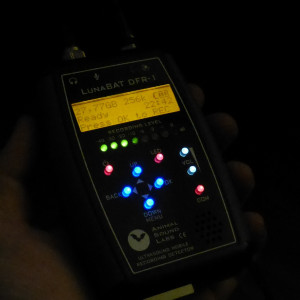
- Sampling rates for Direct High Frequency recording: 192 kHz, 256 kHz (default) and 384 kHz
- Sampling rates for Frequency-Division recording: 24 kHz and 48 kHz (internal HF/FD intelligent switching)
- File format for recordings: WAV-PCM, 16-bit, 1-channel (mono)
- File format for Temperature/Rel. Humidity/Geolocation: TXT-files (they can be converted internally to Google KML file since the v.7.15 firmware)
- Capacity of memory cards: 2-128 GB (tested)
- Signal to noise ratio (for ME-5 microphones): >62 dB
- Recording bandwidth (+/-3dB): from ~200 Hz up to :
- ~190 kHz (S.R.=384 kHz)
- ~126 kHz (S.R.=256 kHz)
- ~95 kHz (S.R.=192 kHz)
- Lower limit frequency (-3dB) with highpass filter (HPF) enabled: 15 kHz
- Total Harmonic and Intermodulation distortions: <0,05% (over recording bandwidth)
- Sensitivity threshold level (with ME-5 mic and 40kHz): ~19 dB SPL
- Levels of recording sensitivity regulation: 128 levels (0 to 127,default: 63)
- Threshold levels for triggered recording: 128 levels (0 to 127,default: 63)
- Replaceable microphones for easy upgrade/service/change directivity and frequency response in the field
- Broadband High Frequency/Direct Ultrasonic Recording on SDHC/SDXC memory cards in popular format
- High quality Delta-Sigma Analog to Digital Converter (clear recording without typical aliasing distortions in SAR-ADC’s)
- Additional high-pass filter switched in the menu (Fd=15 kHz) to eliminate audio interference
- Ability to change the width of the recorded band (and therefore also the size of WAV files) by changing the sampling frequency
- Possibility of a “classic” audio recording – ultrasounds are processed by the built-in FD detector can be saved at lower sampling rates: 24kHz and 48kHz (both of these modes still allows you to record the Lesser horsehoe bat echolocations)
- “COM” switch for recording the spoken comments with temporarily disabled High-Pass Filter and switched the recording source to the linear broadband HF signal
- Linear Amplitude Retention System during live monitoring on speaker or headphones
- High quality industrial grade, waterproof (IP-67) German microphone connector for stable and long lasting work of microphone without disruptions caused by the operation under field conditions
- High quality proffessional grade nickel/gold-plated headphones connector meeting the requirements of the IEEE and ANSI standards for good contact and compliance sized socket with international standards
- Headphone output with high output level for using even with the low sensitivity headphones
- Unique function: built in Temperature along with Relative Humidity sensors (data data are stored in .txt and .kml files and can be previewed on LCD in MENU)
- 8-point level meter (LED line) below the display
- Selected Sampling Rate and the state of High Pass Filter are displayed on LCD
- Built-in real time clock (recordings are marked with the date and time for the recording in WAV file attributes and in the filenames of WAV files)
- Displays current time, the recording time and the amount of available space on the memory card on the LCD
- Displays current GPS position (in the menu)
- Google KML file can be generated on memory card with marked date and time to recognize where the files were recorded (along with the local temp/humidity data)
- Possibility to synchronize internal Real Time Clock with GPS / Glonass clock via GPS/Glonass optional GP-1 or GP-2 receiver with ability to localized time shifting.
- 4-point battery voltage level indicator on the LCD
- Automatic creation of subsequent recordings (3s, 5s, 10s, 15s, 30s, 1m, 2m, 5m, 10m, 20m and 60min each)
- Automatic / triggered recording (128 sensitivity steps with current 7.17b firmware)
- Automatic shutdown of the detector and recording process after battery discharge to a safe level of ~ 1.0V / cell
- Requires just two pieces of the most popular AA cells (primary or Ni-MH batteries)
- Very low power consumption for maximum recording time ~ 6-8h (depending on the capacity of used AA cells) or ~11-14h with listening only (without recording)
- Ability to turn off the LCD backlight, illuminated keyboard (if installed) and the level meter for stealth behaviour or even more savings on power consumption
- Socket with “photographic” 1/4–inch thread for mounting on a tripod or connecting with other photographic accessories
- Rubberized side edges to ensure a good grip even when wearing gloves
- Firm wrist strap
- Lightweight – 175g (without battery and microphone), ca. 200g with batteries and ME-series microphones
- Optional microphone extension cables
- User upgradeable firmware via USB cable and Windows (or Wine equipped LInux machine)
- NEW! – the lower limit frequency of the HPF filter in the FD signal path is now switched from 15kHz to 10kHz at the same time when disabling the HPF filter in the FS recording path (the HPF filter in the FD path is lowered to allow for lower frequencies to be listened and/or recorded in FD recording mode)
- optional GPS/Glonass GP-1 modules for GPS position logging and atomic date/clock synchronisation
- GPS coordinates with the built-in Temp/R.H. sensor data can be generated directly on memory card in Google KML format
- coloured illumination of keys for night visibility in second/alternative SKU#209 version of the detector (3 color groups: red, blue and white keys)
- additional triggered automatic recording mode (selectable in the MENU, sensitivity can be trimmed in 128 steps)
- ability to trim the recording level (in 128 steps in the MENU)
- support for our future high sensitivity Capacitive Microphones with HV polarisation: MC-1 and MC-2 (they will be available shortly)
- additional external temperature and moisture sensors
Comparison of broadband recording quality of LunaBat DFR-1 detector (spectrogram below, ME-4 microphone) with Wildlife Acoustic EM3+ recording (synchronized recordings pasted to right / bottom and left / top channels respectively):

Examples of High Frequency recordings: Recording 1 – Soprano pipistrelle (Pipistrellus pygmaeus) spectrogram:


Recording 2 – Nathusius’s pipistrelle (Pipistrellus nathusii) spectrogram:

Recording 3 – Lesser horseshoe (Rhinolophus hipposideros) spectrogram:

Recording 3 – time expanded (10x slower) preview file.
Recording 3 – time expanded (20x slower) preview file. Original HF file is HERE (right click and “Save link as…”)- possibility to synchronize the internal clock with the exact clock of geolocation systems (with localized time shifting),
- possibility to log the coordinates in text logs,
- possibility to generate popular Google KML files directly on the memory card without the need for additional converters.

Visualization of the same kml file in Google Maps:


- ME-4 detechable broadband microphone;
- MF-1 microphone windscreen (low loss, less than 1.5dB at 200kHz);
- NEW!! – now with set of new generation high capacity rechargeable batteries, 4x AA Fujitsu Black or Panasonic eneloop pro – (both types are manufactured in Japan by FDK Corp., min. 2450mAh, typ. 2600mAh) about 1/3 larger capacity than the “white” Fujitsu / eneloops !
- Waterproof shielded memory card SDHC 32GB class UHS-1 (read speed ~80 MB/s) compatible with the recording at the highest sampling rate (384 kHz) with a plastic box;
- Weatherproof stiffened pouch ET-3 for safe transport and storage of the detector even with the optional GPS receiver connected without having to disassemble it
- GP-1 – Mobile Multi-system GNSS Receiver. More info HERE
- GP-2 – Automotive Multi-system GNSS Receiver. More info HERE
- Spare 32GB SDHC UHS memory card
- Short 17cm UM-1 handle / rail with screws with photo thread (1/4 “UNC-20) for connection to other equipment or photo accessories with tripod thread
- 50cm-3m Microphone extender cables with IP40 / IP65 connectors (waterproof female connector on the microphone side) – cable length on request
- Spare microphone windshield MF-1
- Set of 4 Low Self Discharge rechargeable AA high capacity batteries with plastic box
- Four-channel charger for AA / R6 and AAA / R3 rechargeable batteries Everactive NC-1000 Plus with capacity testing, refresh and other useful functions
- Headphones with mini-jack stereo plug
- Suction cup holder with tripod thread
- Tripods – various types after prior arrangement.
- User Manual for LunaBat DFR-1 detector (v1.0, for FW v7.21b) (PDF, kB) (eng. version under translation)
- User Manual for LunaBat DFR-1 detector (v1.0, for FW v7.21b) (PDF, 1598 kB) PL VERSION>>
- Firmware update pack for LunaBat DFR-1 detector (Release Candidate version 7.35) (ZIP, 1648 kB) DOWNLOAD>>
- Firmware update pack for LunaBat DFR-1 PRO detector (Release Candidate version 7.35) (ZIP, 1649 kB) DOWNLOAD>>
LINKS TO USEFUL TOOLS AND APPLICATIONS:
- GPS Babel multiformat converter (accepts MTK Locus format from GP-1/GP-2 receivers) LINK>>
- Instruction of importing KML files into Google Maps LINK1>> LINK2>>
- GPSvisualizer – online visualization tool LINK>>
- GPSMapEdit – editor & visualizer LINK>>
- WAV file size calculators: LINK1>> LINK2>>
- Offline converter for KML to CSV format: LINK>>
- Online converters for KML to CSV, XLS/XLSX or other formats: LINK1>> and LINK2>>
- Link to QGIS – an open source GIS multiplatform application LINK>>
ARTICLES:
- Triggering bat detectors: Automatic vs. manual mode – LINK>>
- Table of comparative properties of different detectors (pl lang., older detectors) LINK>>
- Table of comparative properties of different detectors (eng lang., more recent detectors) (available soon)
- Guidelines for assessing the impact of wind turbines on bats (pl lang.) DOWNLOAD>>